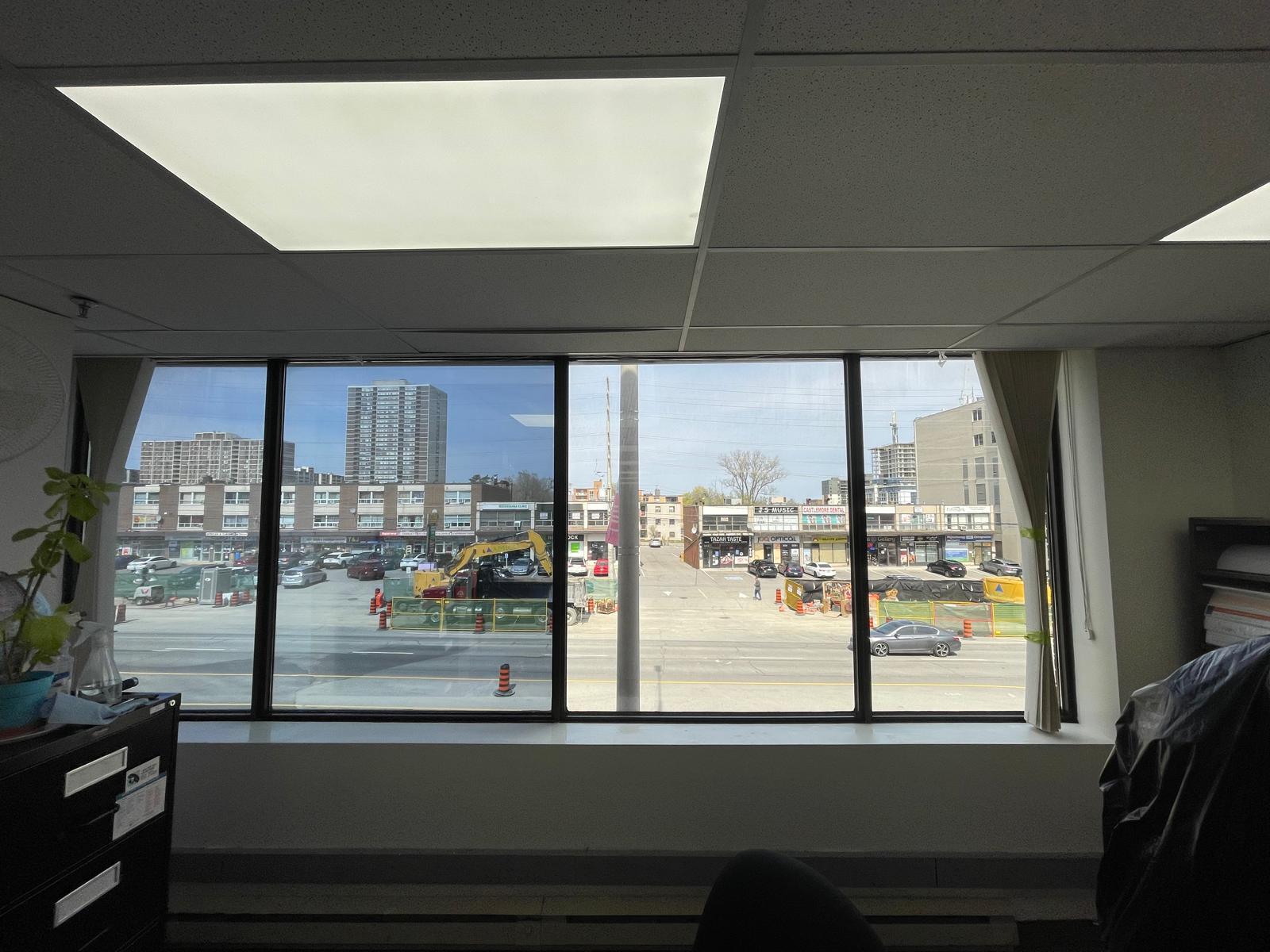

The four main types of privacy window film
Privacy films work in different ways, and the difference matters most after dark.
Frosted (etched-glass) film
Frosted film turns clear glass translucent, like sandblasted glass. Light comes through softly diffused, but shapes and faces don’t — from either side, day or night. It’s the go-to for bathrooms, front-door sidelights, basement windows and ground-floor windows that face the street. Explore our decorative and frosted films.
Decorative and gradient film
Patterned, striped or gradient films give partial privacy — typically obscuring the band of glass at seated or standing eye level — while leaving the top of the window clear for daylight and sky views. They’re popular on glass doors, kitchen windows and home offices where you want privacy without a fully frosted look.
Reflective “one-way mirror” film
Reflective film gives a mirror-like exterior during the day, so people outside see their own reflection instead of your living room. It also rejects a lot of solar heat. But the effect depends entirely on light levels — more on that below.
Blackout and opaque film
Opaque films block the view completely and most or all of the light. They suit glass you never need to see through, such as garage-door windows or storage rooms, but they’re rarely the right choice for living spaces.
The one-way-mirror catch: day vs. night
Reflective film works because the brighter side of the glass sees a reflection and the darker side sees through. During the day the outdoors is far brighter than your home, so the outside sees a mirror. At night that flips: with lights on inside, your home is the bright side, and people outside can see in — while you look out at your own reflection.
That’s why reflective film should never be sold as a stand-alone night-time privacy solution. If you want a clear view by day and privacy at night, pair a lighter film with a covering you can close in the evening, such as zebra blinds or roller shades.
| Film type | Daytime privacy | Night-time privacy | Natural light | Best for |
|---|---|---|---|---|
| Frosted | Full | Full | Soft, diffused | Bathrooms, sidelights, street-facing windows |
| Decorative / gradient | Partial (eye level) | Partial (eye level) | High | Glass doors, kitchens, home offices |
| Reflective (one-way) | Strong | None with lights on | Reduced | Sunny windows where heat is also an issue |
| Blackout / opaque | Full | Full | Little or none | Garages, storage, media rooms |
What security window film does — and doesn’t — do
Security and safety film is a thick, optically clear polyester layer bonded to the inside of your glass with a strong adhesive. When the glass is struck, it still breaks — but the film holds the broken pieces together in the frame instead of letting them fall away. An intruder expecting one quick smash now faces glass that cracks, sags and holds, and has to keep hitting it, which takes time and makes noise.
- It delays forced entry. The goal is to turn a few-second smash-and-grab into a slow, loud, visible effort that many intruders abandon.
- It contains flying glass. Accidental impacts, storms and stray balls are far less dangerous when shards stay in the frame.
- It is not bulletproof or unbreakable. Any glass can eventually be breached with enough force. Film is a deterrent and a delay, not a vault door.
- It adds UV protection. Like most quality window films, clear security films block the vast majority of UV, which helps reduce fading.
Film thickness
Film thickness is measured in mils (thousandths of an inch). Thinner safety films, often around 4 mil, are mainly about holding glass together after accidental breakage. Security films are thicker — commonly 8 mil and up — with heavier commercial films going higher still. Thicker film resists tearing and penetration better, but the right choice depends on the glass and the risk.
Why attachment matters
A standard installation leaves a hair-thin gap between the film edge and the frame. That’s fine for safety film, but a determined intruder can sometimes push an entire filmed pane out of its frame in one piece. For higher-risk glass, an attachment system bonds or mechanically anchors the film to the frame so the glass, film and frame act together. It costs more, but it’s the single biggest upgrade for forced-entry resistance. Learn more about our security and safety films.
Where security film makes the most sense
- Patio and sliding doors — large, often hidden from the street, and a common entry point.
- Sidelights and glass beside door locks — break the glass, reach in, turn the deadbolt.
- Ground-floor and basement windows at the back or side of the house.
- Storefronts and street-level offices — see our security window film in Toronto and Mississauga pages.
Film works best as one layer in a plan that also includes good locks, lighting and an alarm. It buys the time that lets those other layers do their job.
Can you get privacy and security in one film?
Often, yes. Some frosted and tinted films are made on thicker safety-film bases, so a bathroom window or sidelight can be both private and shatter-resistant. Where you need maximum security, a clear security film can be paired with blinds or shades for privacy. We recommend the combination that fits each window rather than one film for the whole house.
Choosing film room by room
| Room / window | Main goal | Usually recommended |
|---|---|---|
| Bathroom window | Privacy day and night | Frosted film |
| Front-door sidelights | Privacy + security | Frosted safety film or clear security film |
| Patio / sliding doors | Security + heat | Security film, often with solar properties |
| Street-facing living room | Daytime privacy + view | Light reflective or gradient film, plus blinds for night |
| Basement windows | Privacy + security | Frosted safety film |
| Home office | Glare + partial privacy | Solar or gradient film |
Living with window film: care and cleaning
Give new film about 30 days to cure before cleaning it (longer in cold weather). After that, clean with a soft cloth or squeegee and a mild, ammonia-free glass cleaner or soapy water. Avoid abrasive pads, razor blades and harsh chemicals on the filmed side. Looked after this way, quality film lasts for many years — and ours is backed by a lifetime residential warranty.